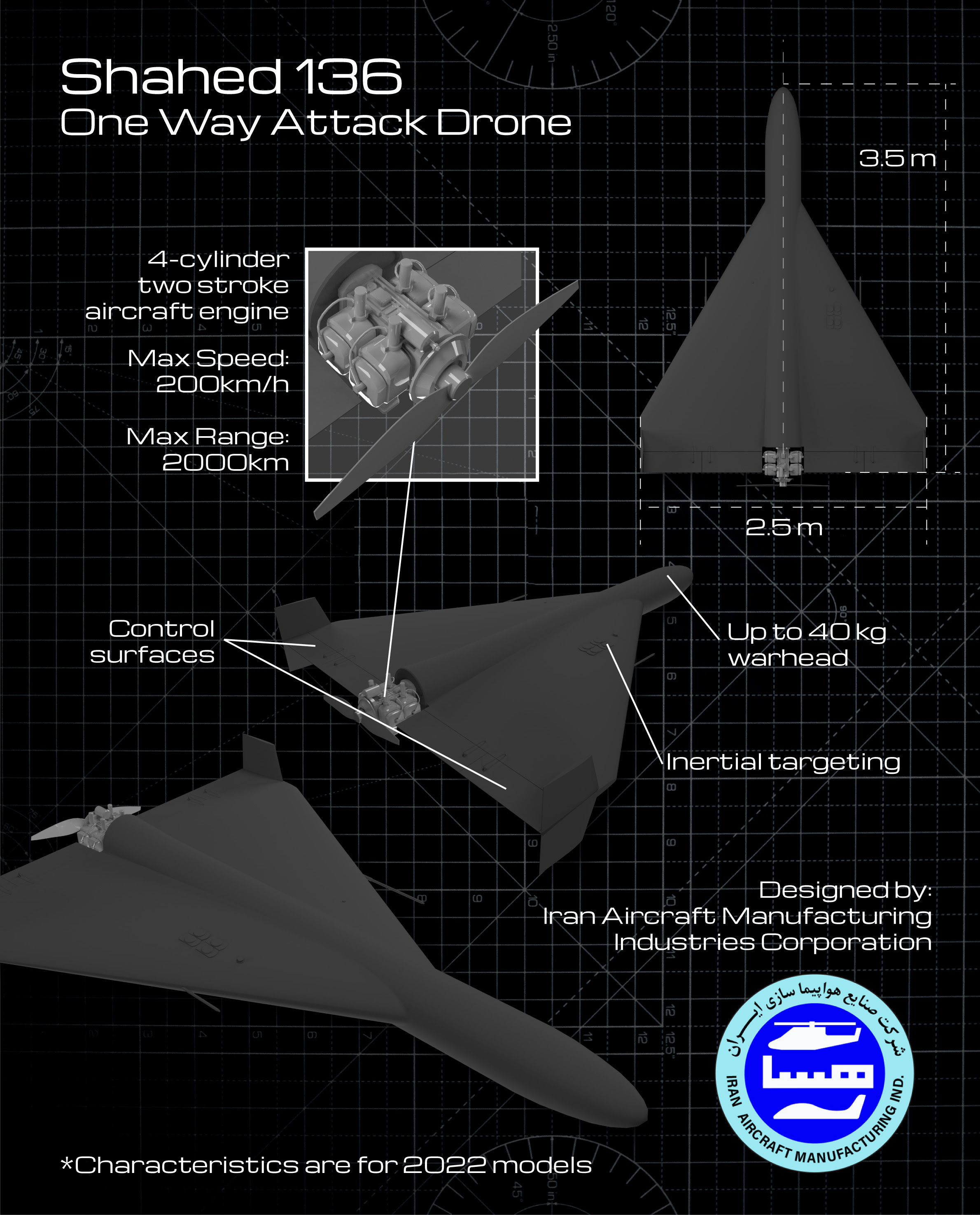
Mass Use and the Economics of AttritionFrom the outset, Russia used the Shahed for mass use, forcing Ukraine to maintain high readiness and expend expensive resources over an extended period. This dynamic turns air defense into an economic duel where the goal is to bankrupt the defender's magazines. - Plummeting Unit Costs: Initially imported from Iran at roughly $193,000 per unit for large orders, Russian localization efforts have driven the cost down significantly. Under the Alabuga franchise agreement, the localized production cost is estimated to have dropped to roughly $48,800 per unit. Russia hopes to cut the cost to less than half that.
- The Cost Asymmetry: This cheap production allows Russia to generate salvos almost daily. Even if only 10% of launched Shaheds penetrate air defenses, a successful strike costs Russia approximately $350,000. By comparison, high-end surface-to-air interceptor missiles often cost upwards of $1 million each.
Rapid Industrial ScalingRussia has successfully transitioned from importing Iranian drones to establishing a robust, localized industrial base capable of mass production. - The Alabuga Hub: According to leaks, Russia signed a $1.75 billion franchise agreement with Iran in early 2023 to produce 6,000 drones. The Alabuga Special Economic Zone in Tatarstan has since dramatically scaled output. By the end of 2025, Russian production was yielding roughly 5,100 Shahed drones and 2,500 decoy drones per month, with reported plans to produce 1,000 drones per day in 2026. The rapid mass production allows Russia to launch the drones the same day they were manufactured.
- Redundant Production Nodes: To reduce reliance on a single vulnerable facility, Russia has expanded production to other sites, including the IEMZ Kupol plant in Izhevsk, which, according to European intelligence, utilizes imported components (including Chinese) to scale output into the thousands. This factory is also where Russia introduces new models and upgrades.
Technological Evolution and "Smart" ModificationsA key challenge is the rapid modernization cycle. While the basic Shahed airframe remains stable, its payload (navigation, communications, warhead, flight algorithms, deception measures) is frequently updated to bypass Ukrainian Electronic Warfare (EW) and kinetic defenses. - EW-Resistant Antennas: In 2024-2025, Ukrainian specialists and media documented drones equipped with advanced counter-EW solutions, such as CRPA antennas (upgraded from 8 to 16 elements) and Kometa adaptive navigation modules to resist GPS spoofing.
- Starlink Integration: In early 2026, Russia also began integrating Starlink terminals to maintain satellite control links. In February 2026, at the request of Ukraine’s Ministry of Defense, SpaceX restricted Russia’s use of Starlink, allowing only authorized terminals to operate in Ukraine.
- Cellular Navigation: Variants have been found carrying cameras and LTE modems equipped with Ukrainian SIM cards, allowing them to transmit data and receive course corrections via civilian mobile networks.
- Jet-Powered Speed: New jet-powered variants, such as the Shahed-238 (also known as Geran-3) fly at over 500 km/h, drastically shrinking the detect-to-engage window for mobile fire groups.
- Warhead Lethality: In 2024-2025, the integration of heavier, thermobaric warheads increased damage caused by even a fraction of breakthroughs, risking devastating damage to hardened infrastructure.
- Anti-Interceptor Defenses: To threaten Ukrainian aerial interceptors, some experimental models have been observed carrying air-to-air missiles.
Operational Use:
From Supplemental Weapon to SaturationRussia’s employment of the Shahed has evolved from a targeted weapon to a technology of mass attrition. - Evading Radar: In early 2022, Shaheds were launched in small groups (6-8 drones). By flying at extremely low altitudes (60–500 meters) with a small radar cross-section, they exploit radar shadows, and are difficult to detect with standard S-300 or Buk systems.
- Multi-Wave Overload: Mass launches of strike drones are now often mixed with decoys. These initial waves are designed to force defenders to expend expensive interceptors and reveal hidden firing positions. This is often followed by route adjustments and waves of cruise or ballistic missiles designed to exploit the newly created gaps in coverage.
- The Persistence Factor: Even when Ukrainian air defenses achieve interception rates of around 90%, the low cost of the drone and its simplicity to produce allows Russia to launch mass salvos almost daily. This constantly strains the system, forcing the dispersion of resources, accelerating repair cycles, and keeping air defense units in a perpetual state of combat readiness.
How Ukraine Adapted:
Layered Defense Against Industrial SaturationInstead of attempting to match volume with volume, Ukraine adapted its air defense architecture around cost discipline, distributed detection, and rapid innovation. - Cost Layering and Target Discipline: Ukraine delegated Shahed interception to a “cheap layer” of Mobile Fire Groups, gun-based systems such as Gepard and Skynex, army aviation, and, increasingly, FPV interceptor drones. In the first half of 2025, Ukraine achieved a 1:55 cost-exchange ratio through the use of interceptor drones, spending approximately $450,000 to destroy $25 million worth of enemy UAVs.
- Distributed Detection Network: To counter low-altitude flight profiles that exploit radar blind spots, Ukraine built a multi-layered sensing architecture combining military radars, a nationwide acoustic network of thousands of microphones (“Sky Fortress”), and civilian reporting through the ePPO app. This expanded detection depth and reduced reaction time.
Electronic Warfare and Adaptive Countermeasures: Nationwide EW systems such as “Pokrova” disrupt navigation and force drones off course, while coordination with commercial providers restricted the use of unauthorized satellite terminals integrated into strike drones. |