Do You Know Why We Need to Save & Invest?+ the Election and the Stock Market+ Your 9-5 job is dying

Newsletter Archive

THE WEALTH PLAN

LETTER SEVENTEEN

Hello Friend,

Welcome to the 17th edition of the Wealth Plan—a newsletter designed to empower and elevate your financial journey!

Yesterday we welcomed our newest member, Denver, a two-month-old wiener dog puppy. My son is absolutely thrilled, and as you can see in the picture below, they bonded instantly!

Let's now dive in,

FINANCIAL LITERACY

Let me start this week by posing a question: Why do you think it's crucial to save and invest?

It all comes down to a key concept in personal finance—the Life Cycle Theory of Saving and Consumption (Deaton, 2005). This theory highlights that throughout our lives, there are periods where our productivity—and consequently our income—will be lower, or even non-existent. Think about times like childhood, retirement, or transitions in our career when we may not have a stable income.

That’s why saving is essential. It prepares us for those times when our income will be reduced or disappear altogether.

According to the Life Cycle Theory, each person goes through three main financial stages:

  1. Formation years – During early life, we don’t work, and we don’t earn an income.
  2. Active life – As working adults, we generate income and accumulate wealth.
  3. Retirement – When work slows down or stops, and our income declines.

Saving and investing throughout these stages helps ensure that our lifestyle remains stable, regardless of life’s changes. With proper planning, you can maintain your quality of life not only for yourself but also for your loved ones.

A key word here is planning. Would you rather indulge in luxuries like lobster and champagne a few times a week, only to struggle the rest of the time? Or would you prefer to maintain a steady, balanced lifestyle that’s both nutritious and sustainable—financially and otherwise?

If you value balance and stability, then planning is essential. And not just a little—consistent, thoughtful planning.

This is why I created the Wealth Plan Coaching Container. Every month, I walk participants through the four pillars that lead to generational wealth (the  Spending Plan, the Income Plan, the Saving Plan and the Investing Plan). And for a limited time, you can join for free!

If you're ready to build long-term financial security and take control of your future, don’t miss this opportunity. Join HERE!


ADVANCED FINANCIAL PLANNING 

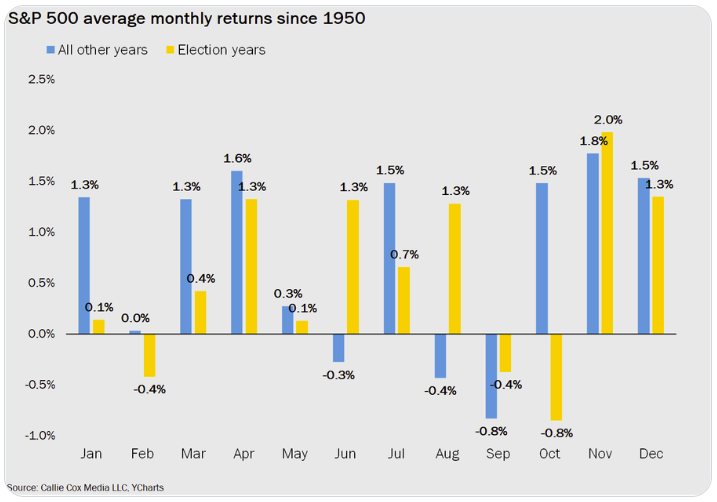
With the U.S. election approaching, the Presidential race is heating up.

I wanted to share the chart below, comparing average monthly returns in non-election years (blue bars) with those in election years (yellow bars). While averages provide insights, they don't guarantee similar outcomes every time—just look at September, which ended with a positive return despite historical trends.

From an investment perspective, there are no clear rules on how specific election outcomes will affect markets.

If you're curious about how election results impact capital markets, U.S. Bank investment strategists analyzed 75 years of data and identified patterns during election cycles. Their findings suggest minimal long-term impact on market performance based on election outcomes. Instead, returns tend to hinge more on economic and inflation trends.

Historically, periods of rising economic growth and declining inflation have been linked to market returns that exceed long-term averages. On the other hand, slower growth and rising inflation tend to produce positive, but below-average, returns.

For investors, focusing on these economic patterns is likely more insightful for predicting market performance than speculating on election outcomes.

Where are we today with macroeconomic data, inflation, fears of recessions, the Fed and interest rates?

The economic landscape is currently somewhat uncertain. Despite the Federal Reserve's recent decision to lower interest rates by half a percentage point to address concerns about a weakening job market, the latest employment data has presented a mixed picture. Nonfarm payrolls increased significantly in September, far exceeding expectations.

I refer to this uncertainty as "noise." This short-term volatility should not deter us from our long-term financial planning and investment goals.

"The best time to invest was 30 years ago. The next best time is now."

2024-10-06_21_09_45-2_Callie_Cox_on_X___Congrats_you_survived_September

BEYOND FINANCE

Reid Hoffman, the visionary founder of LinkedIn who accurately predicted the rise of social media in 1997, recently made a bold statement: "Your 9 to 5 job is dying. By 2034, it’ll be extinct."

This isn't just a sensational headline; it's a stark warning about the rapidly changing nature of work.

The rise of automation, artificial intelligence, and the gig economy is transforming the way we work and earn a living. These shifts are irreversible and will have a profound impact on the job market.

Those who rely solely on traditional 9-to-5 jobs may find themselves at a disadvantage in this evolving landscape.

Given these changes, where does that leave you? Imagine waking up one day to discover that the job you've counted on for years has vanished.

The sense of security you once felt is now gone, leaving you to grapple with the financial uncertainty that comes with job loss.

Instead of fearing this shift, why not embrace it and prepare for the future? By building multiple income streams, you can not only protect yourself from job market uncertainties but also gain financial freedom and flexibility.

I teach about building "diversified and multiple income streams during the second class of my FREE four weeks coaching container.

Don’t miss this opportunity. It's FREE! Join HERE!


Quote of the Week

"In the long run, it's not just how much money you make that will determine your future prosperity. It's how much of that money you put to work by saving and investing it."

Peter Lynch


DISCLAIMER:

The information provided in this newsletter is for educational and informational purposes only and does not constitute financial advice. It is important to consult with a licensed financial professional or advisor before making any investment or financial decisions. Every individual’s financial situation is unique, and any strategies or tips shared here may not be suitable for your specific circumstances. Always conduct your own research and consider seeking professional guidance.

2024-09-15_10_33_26-Logo_Social_Media_Manager_Iniziali_Rosa_-_Logo_-_Canva
photo_2024-10-07_14-06-57

Past Newsletters

Letter One; Letter Two; Letter Three; Letter Four; Letter Five; Letter Six

Letter Seven; Letter Eight; Letter Nine; Letter Ten, Letter Eleven, Letter Twelve, Letter Thirteen

Letter Fourteen  Letter Fifteen  Letter Sixteen

© Copyright, 2024,Elisabetta Basilico,@wealthmamma

You received this email as a customer or subscriber of @wealthmamma Click here to leave mailing list

Sent via

SendPulse