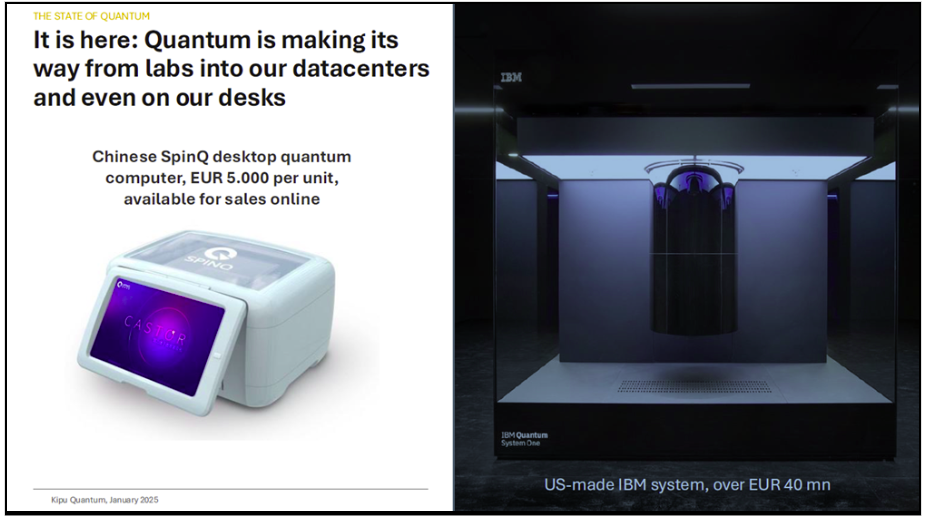
Alphabet CEO Sundar Pichai recently predicted that real-world applications for quantum computers are still 5 to 10 years away. Similarly, at CES in Las Vegas, Nvidia CEO Jensen Huang said practical uses would likely take "decades”. Yet just two months later, Huang took center stage at the Nvidia GTC conference in San Jose, hosting a roundtable focused entirely on the technology. The event, called Quantum Day, served as a “mea culpa” to this promising industry. However, during a recent Quantum and AI Private Investors Circle in Geneva, some key players representing the quantum start up ecosystem were showcasing practical applications indicating that quantum computing is here now. How do we reconcile these two different views? Jensen Huang, Bill Gates, and Sundar Pichai essentially assume a timeline based on combining quantum processors with standard quantum algorithms, which require a massive overhead, and years of development. Differently, Kipu Quantum is revolutionizing quantum computing by making it practical for real-world use. Instead of waiting for future hardware, Kipu optimizes problems to run efficiently on today’s quantum computers. Using a unique co-design approach, the company creates specialized algorithms that are up to 10,000 times shorter and faster than standard quantum algorithms. This breakthrough allows complex computations to be completed before quantum systems lose their quantum stability—something that has been a major hurdle in the field. Kipu's cutting-edge technology is already outperforming both traditional classical computing and other competing quantum methods in key industries. A few examples below: Pharmaceuticals → Development of an algorithm for the protein folding process involving 100 amino acids, using a significantly lower number of qubits: from 3,000,000 qubits with standard algorithms to just 2,000 with Kipu’s proprietary technology—a 1,500-fold reduction! Logistics → In collaboration with BASF, Kipu has developed quantum algorithms that have outperformed conventional solutions by a factor of 600 in optimizing small-scale robotics and logistics challenges. Telecommunications → Working with MasOrange and hardware provider QuEra, Kipu has enhanced network resilience, successfully solving 10% of a large-scale telecommunications problem using only 140 qubits—a significant step toward solving real-world industry challenges with quantum computing. Quantum + AI → By optimizing its algorithms, Kipu has reduced the number of parameters required for training artificial intelligence models by a factor of 1,000. This breakthrough has critical applications, including improving image classification for breast cancer diagnosis (see the notes for a scientific paper published in Quantum Physics by the Kipu Quantum team). Optimization → Kipu recently conducted the largest quantum optimization experiment ever performed on IBM, demonstrating the scalability of its approach. Practical Implications for InvestorsWhat countries are invested in this technology the most? The U.S. and China are currently the two largest investors, with the EU collectively representing another major player in the field. The United States is leading through a combination of private sector innovation and government support. For example: - The National Quantum Initiative Act provides $1.2+ billion in funding
- DARPA, NSA, and other government agencies have their own quantum research programs
- Home to numerous quantum computing startups backed by venture capital
China has the largest government-backed quantum investment at approximately $15.2 billion. Additionally, - It Established the world's largest quantum research facility in Hefei
- Has a strong focus on quantum communications and quantum cryptography
- Has achieved several quantum milestones, including quantum satellite communications
- Explicitly views quantum technology as a national strategic priority
The European Union committed $7.2 billion to quantum technologies through the Quantum Flagship program. Additionally, - It has strong academic research base across multiple countries
- Individual country initiatives supplement EU-wide efforts:
- Germany: €2 billion quantum program
- France: €1.8 billion quantum plan
- Netherlands: Strong quantum ecosystem around QuTech and quantum internet development
- UK: Over £1 billion invested in the National Quantum Technologies Programme
Challenges and Future DirectionsWhile general-purpose quantum computers remain years away, software based applications are a reality today. For investors, understanding this technology provides a window into perhaps the most significant computing revolution since the internet itself. The quantum computing landscape combines characteristics of other technological revolutions: - The transformative potential of the early internet
- The specialized infrastructure demands of cloud computing
- The intellectual property advantages of artificial intelligence
- The national security implications of cybersecurity
As with any technological revolution, early understanding positions investors to recognize opportunities before they become obvious to the broader market. Quantum computing represents an emerging technological frontier with potentially groundbreaking applications across various industries. However, it is essential for private investors to carefully consider both the opportunities and the risks associated with this developing technology: - Risk Tolerance: Investing in quantum computing requires a high tolerance for risk and a long-term perspective, given the uncertainty surrounding the timeline for technological development and adoption.
- Diversification: The investment landscape is vast, encompassing both hardware and software. Hardware remains highly risky, as it is still unclear which key players will succeed in developing a stable and cost-effective solution. In contrast, the software side is more advanced, with solutions already in use. A critical factor for software companies is their ability to select the most suitable hardware for solving specific problems.
- Monitoring Developments: Staying informed about technological advancements and expected timelines for maturity is crucial to adapting investment strategies based on new available insights.
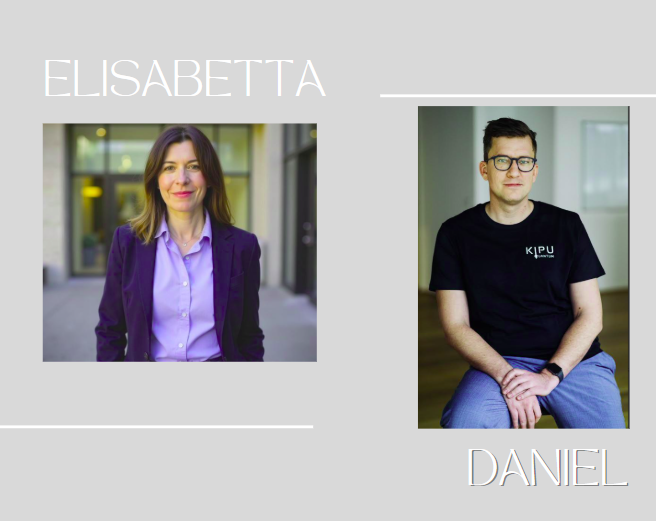
ABOUT THE AUTHORS: |