Quantum Computing 101: Understanding the Next Computing Revolution

Newsletter Archive
2025-04-28_11_55_11-Quantum_Computing__The_Next_Frontier_of_Computation

Quantum computing represents one of the most significant technological advances of the 21st century. While classical computers have transformed our world over the past decades, quantum computers promise to revolutionize fields ranging from drug discovery, artificial intelligence, finance and investing to cryptography. This paper provides an accessible introduction to quantum computing for those without a background in quantum physics or advanced computer science.

A premise: The evolution of classical computing

Computers have come a long way since their invention. Early computers were massive machines that could only solve basic math problems. Over time, we developed smaller, faster, and more powerful computers, leading to the laptops and smartphones we use today. These computers follow the rules of classical physics and use tiny electrical switches called transistors to process information. However, as technology advances, we are reaching the limits of how small and powerful classical computers can get. This is where quantum computing comes in.

Classical computing is what powers your smartphone, laptop, gaming console, and pretty much every electronic device you use.It has been around for seven decades. 

Its main goal is to transform math problems into step-by-step instructions (like following a recipe), store these instructions as code inside computer chips, and then follow each step in order to calculate the answer. In fact,  it processes information using bits (binary digits) that can only be 0 OR 1 - like a light switch that's either OFF or ON.

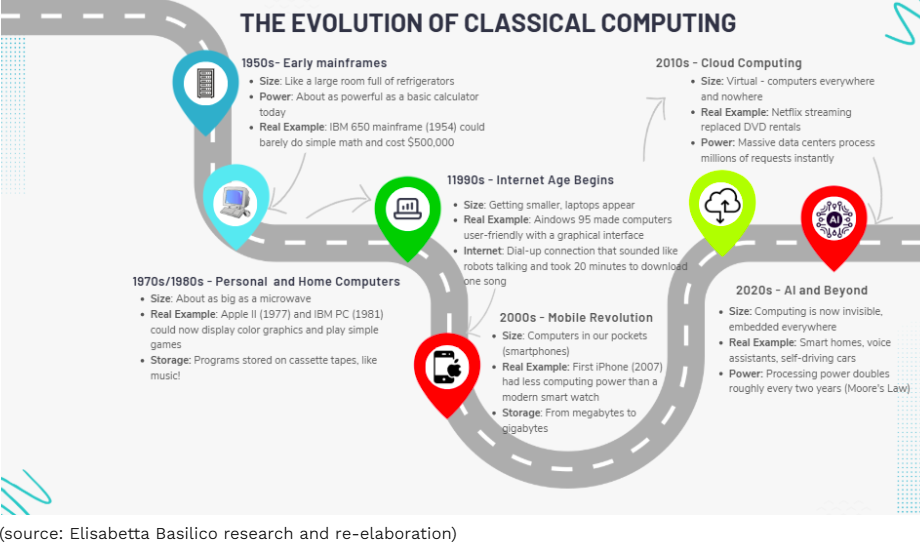
The graphics below is a visual map of how far we have come since the 1950s with Early Mainframes. At the beginning, the IBM 650 mainframe (1954) could barely do simple math and cost $500,000. Imagine if an entire school needed one huge computer just to do the math you can now do on a $1 calculator! Then it was the time of home and personal computers (1970s-1980s) and it was like suddenly everyone could have one at home. With the introduction of the internet in the 1990s, the world became connected but it was very slow ( imagine if loading one TikTok video took longer than watching an entire Netflix movie does today). The 2000s brought the advent of the smart phones but even the first Iphone (2007),  had less computing power than a modern smart watch. With cloud computing in the 2010s it was like  going from having a personal library to having access to every library in the world.

2025-04-28_11_58_01-Quantum_Computing__The_Next_Frontier_of_Computation_-_Google_Docs

Fun Facts to Contextualize How Far We Have Come:

  • The Apollo 11 moon landing computer had less power than a modern key fob
  • A modern smartphone has about 100,000 times more processing power than the computers that guided the first lunar landing
  • One modern SD card can store more data than a 1980s data center that filled a large room

Are we done? Well read below and be surprised!

What is Quantum Computing?

Quantum computing is a new way of processing information using the principles of quantum mechanics—the science that explains how the universe works at the tiniest scales. Unlike classical computers that use bits (which can be either 0 or 1), quantum computers use quantum bits, or qubits, which can be both 0 and 1 at the same time. This allows quantum computers to solve certain problems much faster than traditional computers. Imagine searching for a name in a phone book with 1 million names. A classical computer would check one name at a time, taking a long time to find the right one. A quantum computer, thanks to its unique properties, could check all names at once, making it incredibly fast for certain tasks.

What is a Qubit?

A qubit is the quantum equivalent of a regular computer bit, but with some fascinating differences. 

Regular Computer Bit:

  • Can only be in one of two states: either 0 or 1
  • Like a light switch that's either ON or OFF
  • Once set to 0 or 1, it stays that way until explicitly changed

Qubit:

  • Can be 0, 1, or any combination of both simultaneously (called superposition)
  • Think of it like a spinning coin:
    • While a normal bit is like a coin lying flat (showing either heads or tails)
    • A qubit is like a coin spinning on its edge - in a way, it's both heads AND tails until you stop it and look at it

When you measure a qubit, it "collapses" into either 0 or 1, but before measurement, it exists in multiple states.

Here's a real-world analogy that might help: Imagine you have a friend in a room with two doors (Door 0 and Door 1). With a classical bit, your friend is always standing behind either Door 0 or Door 1. With a qubit, your friend can somehow be behind both doors at once (superposition) until you open one to look – at which point you'll find them behind one specific door.

Let’s explore another example.

Solving a Maze If you're trying to find your way through a maze, 

  • A classical computer would:
  • Try one path
  • If it hits a dead end, back up and try another path
  • Keep doing this until it finds the exit
  • It can only explore one path at a time
  • A quantum computer can explore all possible paths through the maze at the same time:
  • It's like having multiple copies of yourself that each try a different path simultaneously
  • The "copies" that hit dead ends disappear
  • You're left with only the successful path

The power of qubits comes from this ability to be in multiple states at once:

  • 1 qubit can represent 2 states simultaneously
  • 2 qubits can represent 4 states simultaneously
  • 3 qubits can represent 8 states simultaneously
  • And so on exponentially...

This is why a quantum computer with just 300 qubits could theoretically represent more states simultaneously than there are atoms in the observable universe ( which are estimated to be !

If you are wondering about the relevance of all of this, we have got you covered in the next session!

Applications of Quantum Computing

Quantum computing has the potential to transform various industries. According to a recent Mckinsey report “Quantum Technology Monitor”,  four sectors—chemicals, life sciences, finance, and mobility—are likely to see the earliest impact from quantum computing and could gain up to $2 trillion by 2035. 

In fact, it is already helping improve from highly scientific fields such as chemistry and theoretical physics—where solving highly complex simulations would be impossible without this technology—to more practical applications, such as combinatorial optimizations in sectors like logistics, manufacturing, or any industry where planning is essential.

We also know that Artificial Intelligence (AI), which is a standalone technology in itself, can benefit from certain quantum computing applications, particularly in scenarios where massive amounts of data—fundamental to AI’s operation—are not available. This is especially crucial in fields such as medicine and drug development, as well as in industries where forecasting and future predictions are at the core of the business, such as finance.

Another area of massive potential impact is cryptography, as quantum computing can both break traditional encryption systems and create security protocols that are impervious to even the most skilled hackers, ultimately leading to enhanced cybersecurity.

Lastly, a key general advantage of quantum computing is its ability to reduce energy consumption compared to other technologies, such as AI. Below some additional specific examples:

  • Medicine and Drug Discovery: Quantum computers can quickly analyze molecules to develop new medicines faster than classical computers.
  • Cryptography and Cybersecurity: They can crack traditional encryption but also create unbreakable security systems.
  • Artificial Intelligence: They can process massive amounts of data more efficiently, improving AI and machine learning outcomes such as the ability to diagnose with greater accuracy the presence of breast tumors from images.
  • Finance and Investment: They can optimize investment portfolios, predict market trends, and solve complex financial problems.
  • Climate and Weather Forecasting: They can analyze climate models more accurately, helping predict extreme weather events.

Current State of the Technology

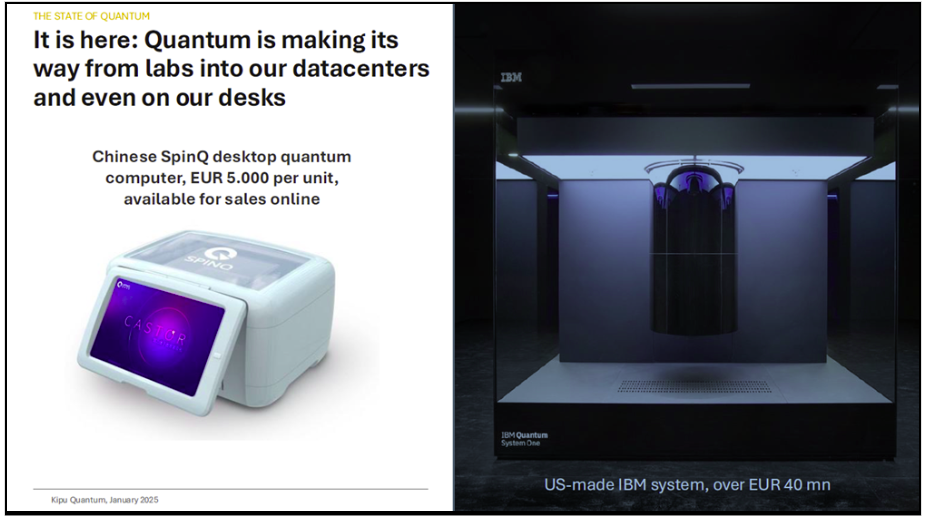
Let’s start by showing two (very different indeed) quantum computers that are real!

The one to the left of the picture below is a portable solution,made by the chinese SpinQ and which you can buy online for $5,000 while the one to the right is System One, produced by IBM with a price tag of 40 million (!) and currently located in Germany. Spin Q is much less powerful than SystemQ and can only be used for educational purposes. SystemQ is used via the cloud by many companies already.

2025-04-28_12_00_19-Quantum_Computing__The_Next_Frontier_of_Computation_-_Google_Docs

Alphabet CEO Sundar Pichai recently predicted that real-world applications for quantum computers are still 5 to 10 years away. Similarly, at CES in Las Vegas, Nvidia CEO Jensen Huang said practical uses would likely take "decades”. Yet just two months later, Huang took center stage at the Nvidia GTC conference in San Jose, hosting a roundtable focused entirely on the technology.

The event, called Quantum Day, served as a “mea culpa” to this promising industry.

However, during a recent Quantum and AI Private Investors Circle in Geneva, some key players representing the quantum start up ecosystem were showcasing practical applications indicating that quantum computing is here now.

How do we reconcile these two different views?

Jensen Huang, Bill Gates, and Sundar Pichai essentially assume a timeline based on combining quantum processors with standard quantum algorithms, which require a massive overhead, and years of development. 

Differently, Kipu Quantum is revolutionizing quantum computing by making it practical for real-world use. Instead of waiting for future hardware, Kipu optimizes problems to run efficiently on today’s quantum computers. Using a unique co-design approach, the company creates specialized algorithms that are up to 10,000 times shorter and faster than standard quantum algorithms. This breakthrough allows complex computations to be completed before quantum systems lose their quantum stability—something that has been a major hurdle in the field.

Kipu's cutting-edge technology is already outperforming both traditional classical computing and other competing quantum methods in key industries. A few examples below:

Pharmaceuticals → Development of an algorithm for the protein folding process involving 100 amino acids, using a significantly lower number of qubits: from 3,000,000 qubits with standard algorithms to just 2,000 with Kipu’s proprietary technology—a 1,500-fold reduction!

Logistics → In collaboration with BASF, Kipu has developed quantum algorithms that have outperformed conventional solutions by a factor of 600 in optimizing small-scale robotics and logistics challenges.

Telecommunications → Working with MasOrange and hardware provider QuEra, Kipu has enhanced network resilience, successfully solving 10% of a large-scale telecommunications problem using only 140 qubits—a significant step toward solving real-world industry challenges with quantum computing.

Quantum + AI → By optimizing its algorithms, Kipu has reduced the number of parameters required for training artificial intelligence models by a factor of 1,000. This breakthrough has critical applications, including improving image classification for breast cancer diagnosis (see the notes for a scientific paper published in Quantum Physics by the Kipu Quantum team).

Optimization → Kipu recently conducted the largest quantum optimization experiment ever performed on IBM, demonstrating the scalability of its approach.

Practical Implications for Investors

What countries are invested in this technology the most?

The U.S. and China are currently the two largest investors, with the EU collectively representing another major player in the field.

The United States is leading through a combination of private sector innovation and government support. For example: 

  • The National Quantum Initiative Act provides $1.2+ billion in funding
  • DARPA, NSA, and other government agencies have their own quantum research programs
  • Home to numerous quantum computing startups backed by venture capital

China has the largest government-backed quantum investment at approximately $15.2 billion. Additionally,

  • It Established the world's largest quantum research facility in Hefei
  • Has a strong focus on quantum communications and quantum cryptography
  • Has achieved several quantum milestones, including quantum satellite communications
  • Explicitly views quantum technology as a national strategic priority

The European Union committed $7.2 billion to quantum technologies through the Quantum Flagship program. Additionally,

  • It has strong academic research base across multiple countries
  • Individual country initiatives supplement EU-wide efforts:
    • Germany: €2 billion quantum program
    • France: €1.8 billion quantum plan
    • Netherlands: Strong quantum ecosystem around QuTech and quantum internet development
    • UK: Over £1 billion invested in the National Quantum Technologies Programme

Challenges and Future Directions

While general-purpose quantum computers remain years away, software based applications are a reality today. 

For investors, understanding this technology provides a window into perhaps the most significant computing revolution since the internet itself.

The quantum computing landscape combines characteristics of other technological revolutions:

  • The transformative potential of the early internet
  • The specialized infrastructure demands of cloud computing
  • The intellectual property advantages of artificial intelligence
  • The national security implications of cybersecurity

As with any technological revolution, early understanding positions investors to recognize opportunities before they become obvious to the broader market.

Quantum computing represents an emerging technological frontier with potentially groundbreaking applications across various industries. However, it is essential for private investors to carefully consider both the opportunities and the risks associated with this developing technology:

  • Risk Tolerance: Investing in quantum computing requires a high tolerance for risk and a long-term perspective, given the uncertainty surrounding the timeline for technological development and adoption.
  • Diversification: The investment landscape is vast, encompassing both hardware and software. Hardware remains highly risky, as it is still unclear which key players will succeed in developing a stable and cost-effective solution. In contrast, the software side is more advanced, with solutions already in use. A critical factor for software companies is their ability to select the most suitable hardware for solving specific problems.
  • Monitoring Developments: Staying informed about technological advancements and expected timelines for maturity is crucial to adapting investment strategies based on new available insights.

ABOUT THE AUTHORS:

2025-04-28_12_06_45-Brown_Minimalist_Family_Two_Photo_Collage_-_Collage_di_foto_-_Canva

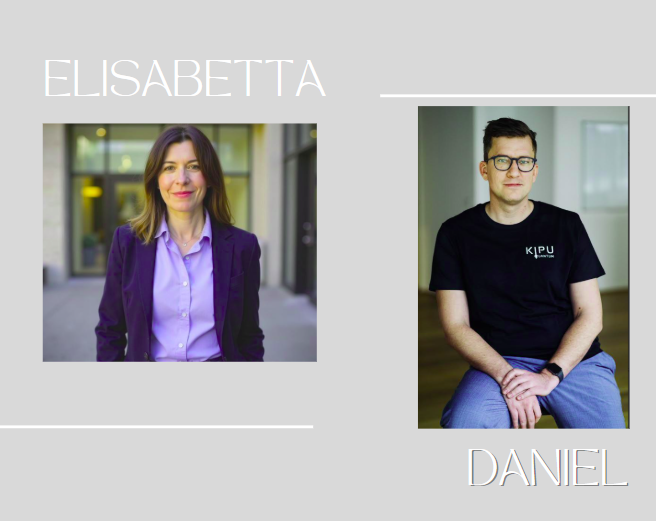
Elisabetta Basilico, PhD, CFA, is an investment professional, financial educator, and published author with over 20 years of experience advising institutional and private investors. Her work spans the full investment value chain, from governance and the investment policy statements to asset allocation and innovations in investment strategies.

Passionate about democratizing access to investment research and advancing financial education, Elisabetta combines rigorous scientific grounding with a pragmatic approach to solving real-world portfolio challenges. Throughout her career, she has helped several investors achieve resilient, long-term results across global wealth portfolios, always striving to make complex concepts accessible and actionable.

Elisabetta earned her PhD in Finance from the University of St. Gallen (Switzerland) and has been a Chartered Financial Analyst (CFA) charterholder since 2007. She has contributed to teaching and research at various international universities and co-authored numerous articles including papers in peer-reviewed journals. In 2019, she co-authored Smarter Investing: How Academic Insights Propel the Savvy Investor, published by Palgrave MacMillan, bridging academic insights and practical investing. She writes a weekly blog for the Alpha Architect research platform.

Daniel Volz is co-founder and CEO of Kipu Quantum GmbH, a quantum computing company with the mission to shorten the waiting time for industrial quantum advantage for end users by leveraging application- and hardware-specific algorithms.

Before, he gathered one-of-kind insights into the industrial user’s perspective on and needs for quantum computing solutions. Daniel served as a project lead with BASF SE, the world's largest chemical producer & chemical research company, working on the strategic impact of quantum computing and other corporate development related topics. Beyond chemicals, during his time as a senior consultant in McKinsey's Frankfurt office, he built up McKinsey's quantum computing capabilities and consulted clients in verticals such as chemicals, pharma, oil & gas, banking, automotive and electronics.

In his twenties, he spent more than eight years co-building a specialty chemicals start-up company as the first non-founder employee (hightech and electronic chemicals). During this journey, he mastered areas from R&D to managing projects and teams of various sizes. As team lead, he build up a chemistry lab and lead a diverse team of more than 20. He also tapped into product development and strategic marketing to reach market readiness for deep-blue TADF technology, which is commercialized in OLED displays to drastically decrease the power consumption of hand-held devices and enable better displays.

Daniel holds a PhD in chemistry from Karlsruhe Institute of Technology & the Karlsruhe School of Optics and photonics. He started his professional career as a freelance journalist on the mission to break down science into something reader's could enjoy with their morning coffee.


© Copyright, 2025,Elisabetta Basilico,PhD,CFA

Sent via

SendPulse